
Satisfyer Pro 2 Generation 2 Intensity Levels Explained: All 11 Settings
Satisfyer Pro 2 Generation 2 intensity levels explained, from the lowest intensity to the highest setting, with a practical guide to changing intensity and choosing the right level.
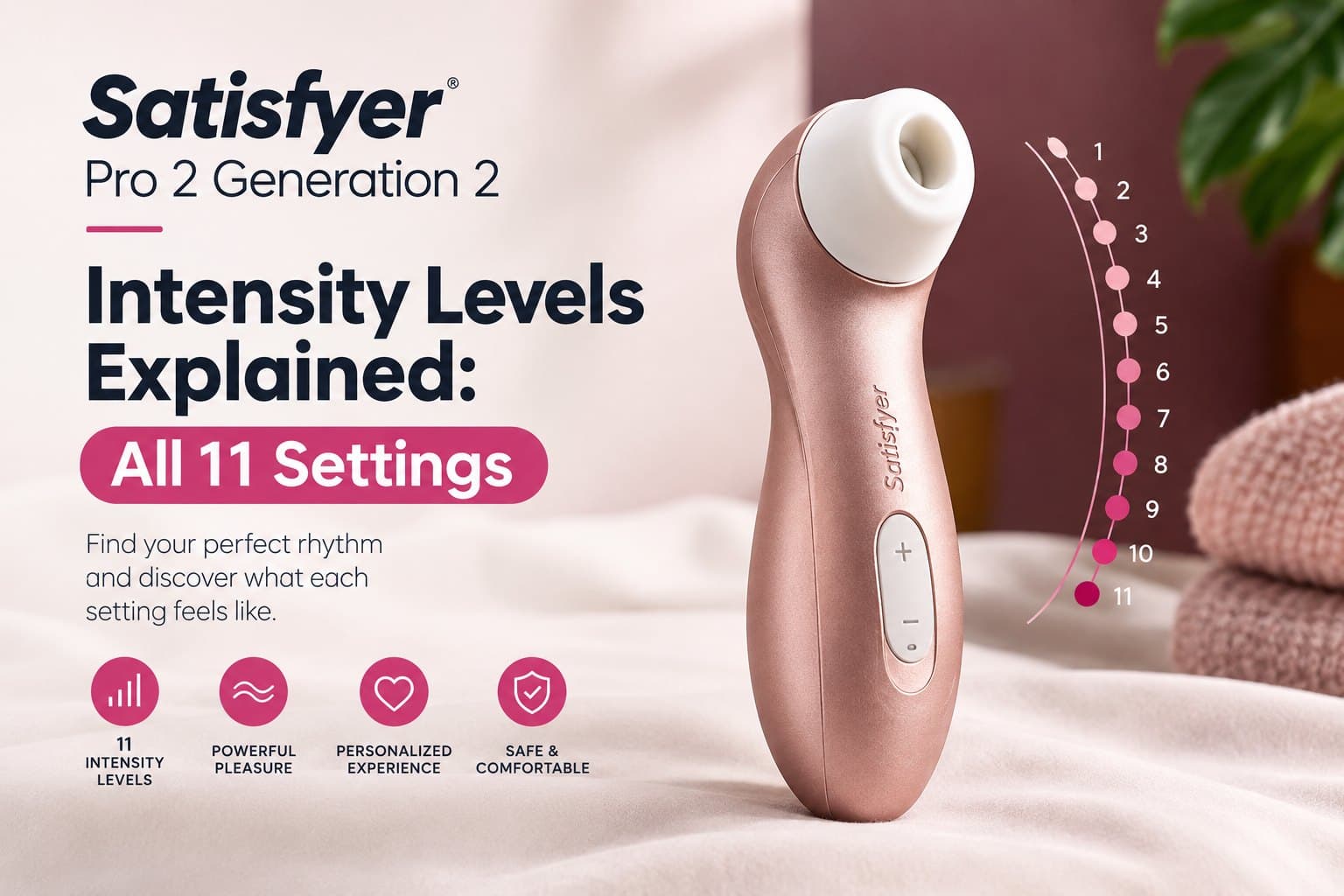
Satisfyer Pro 2 Generation 2 Intensity Levels Explained: All 11 Settings
If you are trying to understand the Satisfyer Pro 2 Generation 2 intensity levels, the most useful place to start is simple: the device has 11 pressure-wave intensities, ranging from Level 1 through Level 11.
That gives you a broad control range, but the numbers do not represent fixed measurements of pressure or a scientifically defined sensation at each step.
That distinction matters.
The Satisfyer Pro 2 Generation 2 uses Air-Pulse technology, which creates pressure waves around the clitoral area rather than relying on conventional direct-contact vibration. Its controls allow you to move through 11 intensity levels, giving you multiple points between the gentlest and strongest ends of the available range.
The official product information does not assign a technical pressure value to Level 1, Level 2, Level 3, and so on. There is no manufacturer-published table stating that one setting corresponds to a particular pressure measurement.
So this guide takes a practical approach.
Rather than inventing measurements that are not published, we explain what each of the 11 settings represents within the overall intensity range, how to move between them, and how to choose a level that makes sense for your own sensitivity and experience.
The short version is straightforward:
Level 1 is the lowest point in the range, while Level 11 is the highest. The settings between them provide progressively stronger points across the available range.
You do not have to work your way to Level 11, and the highest setting is not automatically the most appropriate setting.
---
First, what exactly are the 11 settings controlling?
The Pro 2 Generation 2 uses Satisfyer's Air-Pulse technology.
Instead of relying on a conventional vibrating motor pressing directly against the body, the device creates pressure waves around the clitoral area through its silicone head.
The silicone opening is designed to fit around the clitoris. Correct positioning is important because the Air-Pulse effect depends on the head sitting snugly enough for the pressure waves to work as intended.
The device has an optimized button design that allows you to move through its 11 pressure-wave levels.
In practical terms, each higher number represents a stronger point in the available intensity range.
That does not mean the difference between every number will feel identical.
The jump from one setting to the next may seem subtle at one point in the range and more noticeable at another. Your perception can also change depending on positioning, sensitivity, contact, and how accustomed you are to Air-Pulse stimulation.
For more background on the technology itself, see our guide to how Air-Pulse technology works.
If you are comparing this sensation with a traditional vibrator, Air-Pulse vs. conventional vibration explains the difference in more detail.
---
The 11 intensity levels at a glance
| Level | Practical position in the range | Best way to think about it |
|---|---|---|
| 1 | Lowest | Gentle introduction and initial positioning |
| 2 | Very low | Slight increase while staying close to the gentle end |
| 3 | Low | Low-intensity exploration |
| 4 | Low-to-moderate | A noticeable step up from the lower range |
| 5 | Moderate | Comfortable middle territory for many users |
| 6 | Moderate | A balanced setting between gentle and strong |
| 7 | Moderate-to-strong | More pronounced pressure-wave intensity |
| 8 | Strong | Stronger stimulation for users who prefer more intensity |
| 9 | Strong | Upper-range intensity with a substantial increase from the middle |
| 10 | Very strong | Near the top of the available range |
| 11 | Highest | Maximum numbered intensity |
This table is a practical intensity guide, not an official Satisfyer specification chart.
Satisfyer confirms that there are 11 pressure-wave intensities, but it does not publish a separate laboratory pressure measurement for each numbered setting.
The descriptions below are therefore intended to help you understand the progression rather than claim that a particular level produces a precisely measurable sensation.
---
Level 1: The lowest intensity
Level 1 is the natural starting point when you want the gentlest available setting.
It is particularly useful when you are new to Air-Pulse stimulation, returning to the device after a break, or simply want to establish the correct position before increasing the intensity.
At this point, the goal does not need to be maximum stimulation.
Think of Level 1 as an orientation setting. It gives you an opportunity to make sure the silicone head is sitting correctly and that the pressure-wave sensation feels comfortable.
If the device does not seem to be producing the expected sensation, increasing the intensity immediately is not always the answer.
Check the position first.
Satisfyer's instructions emphasize placing the opening directly over the clitoris and creating a snug fit. Excessive pressure from the device can actually reduce the sensation rather than improve it.
For a first session, Level 1 can therefore be useful for learning the relationship between positioning and sensation before exploring the rest of the range.
When Level 1 makes sense
Level 1 can be a sensible choice when:
- You are new to Air-Pulse technology.
- You want to understand the sensation before increasing intensity.
- You are particularly sensitive.
- You want to focus on positioning first.
- You are returning to the device and want to start gently.
There is no requirement to move beyond Level 1 if it already provides the level of stimulation you want.
---
Level 2: A gentle step upward
Level 2 remains close to the lowest end of the range, but gives you a little more intensity than Level 1.
This can be useful if Level 1 feels comfortable but too mild for your preference.
Instead of making a large jump, you can move one step upward and see how your body responds.
One advantage of having 11 settings is precisely this ability to make relatively small changes.
You do not have to choose between a very gentle setting and a very strong one.
Level 2 can also be useful when you want to maintain a lower intensity while becoming more familiar with the device's characteristic Air-Pulse sensation.
It is still early in the intensity range, so it can provide a useful transition between initial positioning and more pronounced stimulation.
---
Level 3: Low-intensity exploration
Level 3 sits firmly within the lower part of the 11-level range.
By this point, you have moved beyond the minimum setting while still leaving plenty of room to increase intensity later.
For someone who finds higher settings overwhelming, the lower range can be enough to provide useful control.
For someone who prefers stronger stimulation, Level 3 may instead function as a warm-up before moving upward.
The important point is that there is no requirement to progress through every number during every session.
The intensity scale is there to give you control, not to create a sequence that you have to complete.
If Level 3 provides the intensity you want, there is no practical reason to increase simply because Levels 4 through 11 are available.
---
Level 4: Low-to-moderate intensity
Level 4 begins to move toward the middle of the available range.
It can be thought of as a transition point.
You are no longer close to the gentlest settings, but you still have considerable headroom before reaching the strongest levels.
This is where gradual adjustment becomes particularly useful.
If Level 3 feels comfortable but you want more stimulation, moving to Level 4 lets you evaluate a relatively small increase rather than making a large jump.
Remember that perceived intensity is affected by more than the number displayed by the control.
A well-positioned silicone head can make the Air-Pulse effect feel substantially different from an incorrectly positioned one.
If Level 4 feels stronger than expected, there is no need to compensate by pressing the device more firmly. Correct positioning is more important than physical pressure.
---
Level 5: The middle of the range
Level 5 is approximately the midpoint of the 11-setting scale.
For readers looking for a straightforward intensity settings guide, this is a useful reference point.
You have four numbered settings below Level 5 and six above it, placing Level 5 around the centre of the scale.
That does not make it an officially designated "normal" setting.
Satisfyer does not describe Level 5 as the recommended level for everyone.
Instead, it is simply a useful middle reference when thinking about the 11 available steps.
If you have already become comfortable with the lower settings, Level 5 gives you an opportunity to explore a more pronounced level without immediately moving toward the top of the scale.
For some users, the middle of the range may be where they find their preferred intensity. For others, it may be too mild or too strong.
The number itself cannot determine that.
---
Level 6: A balanced middle setting
Level 6 takes you just above the midpoint.
This can be a useful setting to explore when the lower half of the range feels too mild but the upper levels seem unnecessary.
Because individual sensitivity varies, there is no universal definition of what Level 6 should feel like.
One person's comfortable setting may be another person's upper limit.
The practical value of the level is that it gives you another incremental choice between the lower and higher parts of the scale.
If you find yourself repeatedly moving between Level 5 and Level 7, Level 6 can help you fine-tune the experience rather than settling for a setting that is slightly weaker or stronger than you prefer.
That is one of the practical benefits of having 11 intensity levels: you have more points at which to make adjustments.
---
Level 7: Moderate-to-strong intensity
Level 7 moves into the stronger half of the available range.
At this point, the pressure-wave effect is positioned well above the lowest settings, making Level 7 a useful reference for people who already know that they prefer more intensity.
It is still important not to equate a higher number with a better experience.
The purpose of the upper half of the scale is to provide more intensity options for people who want them.
It does not mean every user should aim for this range.
If Level 7 feels too intense, simply step back.
If it feels comfortable and you want more, Levels 8 through 11 remain available.
The useful feature here is flexibility. You can move up or down rather than having to commit to a single intensity.
---
Level 8: Strong intensity
Level 8 is firmly within the stronger end of the 11-level range.
This is where the difference between the lower and upper portions of the scale may become more apparent for users who are sensitive to changes in Air-Pulse intensity.
A useful way to approach Level 8 is to treat it as an option rather than a destination.
If you have gradually increased the intensity and Level 8 remains comfortable, there is no reason to move higher simply because higher settings are available.
Likewise, if Level 8 feels too strong, moving down to Level 7 or Level 6 is a normal part of using an adjustable device.
The number is there to provide control.
It is not a score.
---
Level 9: Strong upper-range intensity
Level 9 sits close to the top of the available intensity range.
For users who prefer stronger pressure-wave stimulation, this setting provides a substantial amount of room above the midpoint settings while still leaving Levels 10 and 11 available.
The upper range is also where correct positioning becomes particularly important.
The Pro 2 Generation 2 is designed to work with the silicone head positioned around the clitoral area.
Applying additional physical pressure is not a substitute for correct positioning and can reduce the sensation.
If Level 9 feels intense enough, there is no practical reason to continue increasing simply to reach the maximum number.
A useful intensity setting is the one that provides the experience you want, not necessarily the one with the largest number.
---
Level 10: Very strong intensity
Level 10 is one step below the highest numbered setting.
At this point, you are close to the upper limit of what the device's 11-level control range offers.
For someone who prefers strong stimulation, Level 10 provides another choice before the maximum setting.
That single step matters because intensity preference is personal.
Some users may find Level 10 more suitable than Level 11, while others may prefer a lower level altogether.
The most useful way to think about Level 10 is therefore as a high-intensity option, not as a target that should be reached during every session.
If it feels too strong, reducing the intensity is a perfectly normal part of using the device.
---
Level 11: The highest intensity
Level 11 is the highest numbered intensity setting on the Satisfyer Pro 2 Generation 2.
It represents the strongest point in the device's available pressure-wave range.
If you want to know what the "highest intensity" means in simple terms, this is it:
Level 11 is the maximum selectable level.
But "maximum" does not mean "best."
It simply describes the top of the control range.
For users who prefer strong Air-Pulse stimulation, Level 11 provides access to the full intensity range.
For others, a lower setting may be more comfortable or more effective.
If a high setting feels uncomfortable, there is no benefit in forcing yourself to remain there.
There is also an important distinction between Level 11 and a technical measurement.
Satisfyer confirms 11 pressure-wave intensities but does not publish a pressure figure that can be assigned to Level 11 in a specification table.
We therefore would not describe Level 11 as a particular number of millibars, pascals, or any other pressure unit without a verified technical source.
---
Does each level feel noticeably different?
Not necessarily in exactly the same way for every person.
An 11-step control system gives you multiple points across the intensity range, but human perception is not a measuring instrument.
The difference between two adjacent levels may be obvious in one situation and relatively subtle in another.
Several factors can influence what you perceive:
Positioning
The silicone head needs to sit correctly around the clitoral area.
Contact and fit
Air-Pulse stimulation depends on an appropriate fit and contact between the silicone head and the body.
Individual sensitivity
People can respond differently to the same intensity setting.
Familiarity
The sensation may feel different when you are new to Air-Pulse technology compared with repeated use.
Position during use
Small changes in positioning can affect how the pressure-wave effect is perceived.
Physical pressure
Pressing the device harder is not necessarily a way to increase useful sensation.
This is why an intensity settings guide should explain the range rather than promise an identical experience at every level.
---
How do you change intensity?
The Pro 2 Generation 2's optimized button design allows you to click through its 11 pressure-wave levels.
The important practical habit is to make adjustments gradually rather than repeatedly jumping from the lowest setting to the highest.
A simple approach is:
- Start at Level 1. Give yourself time to become familiar with the sensation.
- Check positioning. Make sure the silicone opening is correctly placed before assuming you need more intensity.
- Increase one or two levels. Notice the difference rather than immediately going to the top.
- Pause when the intensity feels right. You do not have to keep increasing.
- Move down if necessary. Reducing intensity is part of normal adjustment.
- Reposition rather than pressing harder. Correct fit is important to Air-Pulse performance.
Satisfyer's usage guidance recommends starting on a gentle setting and holding the device still.
It also notes that too much pressure can reduce the sensation.
That makes the relationship between intensity, positioning and pressure particularly important.
---
Why choosing an intensity level is more important than reaching Level 11
The number on the device is only one part of the experience.
Someone new to Air-Pulse technology may get more useful information from Levels 1 through 4 than from immediately selecting Level 11.
Someone who already knows they prefer strong pressure waves may naturally explore the upper half of the range more quickly.
Neither approach requires a universal progression.
The better question is:
Which setting gives you the level of stimulation you actually want?
That may change from one session to another.
A setting that feels appropriate at one point may feel too strong or too mild later.
The 11-level control exists so that you can make that adjustment without being locked into a single intensity.
---
What if the lowest setting already feels strong?
If Level 1 feels stronger than expected, there is no requirement to increase the intensity.
The Pro 2 Generation 2 uses a distinctive pressure-wave sensation rather than conventional vibration, so someone accustomed to vibrating products should not assume that the lowest Air-Pulse setting will feel like the lowest setting on a conventional vibrator.
Positioning can also make a significant difference.
Before concluding that the device is too intense, make sure the silicone head is positioned correctly and that you are not applying unnecessary pressure.
If Level 1 is comfortable but already provides enough stimulation, Level 1 is a perfectly valid setting to use.
The existence of ten higher levels does not make them necessary.
---
What if Level 11 does not feel as strong as expected?
The opposite situation can also happen.
If the highest setting does not feel as strong as you expected, increasing physical pressure is not necessarily the solution.
Start with positioning.
The Pro 2 Generation 2 is designed to produce its characteristic Air-Pulse effect when the opening is correctly positioned and has appropriate contact around the clitoral area.
Satisfyer specifically advises placing the opening over the clitoris and maintaining a snug fit.
It also advises holding the device still and notes that too much pressure can reduce sensation.
This is an important point for anyone searching for the highest intensity:
Maximum electronic intensity does not guarantee maximum perceived sensation if the device is positioned poorly.
Before assuming that Level 11 is not powerful enough, check the basics of positioning and fit.
---
Is Level 11 always the strongest experience?
Level 11 is the strongest setting, but that is not necessarily the same thing as the strongest experience for every person.
Perceived intensity depends on the interaction between the device, its position and the individual using it.
A lower setting that feels comfortable and well-positioned can be more effective for a particular user than a maximum setting that feels overwhelming or uncomfortable.
This is also why the phrase "strongest setting" should be interpreted literally.
Level 11 is the top control setting.
It is not a promise about how every person will experience it.
---
A practical way to find your preferred setting
If you are unsure where to begin, try thinking about the 11 levels as three broad zones rather than 11 numbers you must test in order.
Levels 1–4: Explore and establish comfort
The lower range is useful for getting familiar with the device, checking positioning and identifying how your body responds to Air-Pulse stimulation.
If you are new to this technology, there is nothing wrong with spending most of your time in this range.
Levels 5–7: Find your working range
The middle section gives you several options around and above the centre of the scale.
This can be useful if the lowest settings are too mild but the upper range feels unnecessary.
For many users, this is simply an area to explore rather than a prescribed target.
Levels 8–11: Explore stronger intensity
The upper range is designed for users who want stronger pressure-wave stimulation.
There is still no need to use the highest setting simply because it exists.
This three-zone approach is not an official Satisfyer classification.
It is simply a practical way of making an 11-level control system easier to understand.
---
Intensity and positioning work together
One of the easiest mistakes with Air-Pulse devices is to think about intensity as if it were completely independent from positioning.
It is not.
The Pro 2 Generation 2's silicone head is designed to surround the clitoral area, and the Air-Pulse effect depends on an appropriate fit.
If the opening is not positioned correctly, increasing the intensity may not solve the problem.
A better sequence is:
Position → establish contact → start low → adjust intensity → fine-tune position if necessary.
This approach is more useful than simply selecting a high number and pressing the device more firmly against the body.
The device is designed around pressure waves and a working chamber, so the fit is part of the mechanism rather than a minor detail.
If you want to understand the cleaning and maintenance side of the device after use, see our Satisfyer Pro 2 cleaning guide.
---
Does lubricant affect intensity?
Satisfyer notes that a small amount of water-based lubricant around the rim can help the device fit better and intensify the sensations.
That does not mean lubricant changes the electronic intensity setting.
Level 5 remains Level 5, for example.
Rather, the physical fit can affect how the Air-Pulse sensation is perceived.
This is another reason not to treat the numbered settings as isolated measurements.
The same setting can feel different when the fit and positioning change.
If you use lubricant, a water-based lubricant is the type specifically referenced in Satisfyer's guidance.
---
How the intensity settings relate to noise
Intensity is also relevant when thinking about the Pro 2 Generation 2's sound.
The device is designed with a whisper-quiet motor, but "whisper quiet" does not mean absolutely silent.
The practical sound level can also depend on positioning and the environment.
If privacy is one of your main concerns, our separate guide How Loud Is the Satisfyer Pro 2 Generation 2? Noise Levels Explained looks specifically at bedroom use, shared accommodation, room acoustics and higher settings.
The important distinction is that intensity and noise are different characteristics.
A higher intensity setting does not give you a published decibel value, and Satisfyer does not provide setting-by-setting dB measurements for the Pro 2 Generation 2.
Therefore, it would be misleading to say that Level 11 produces a particular sound level without an appropriate measurement source.
---
The biggest mistake to avoid: treating the numbers like a score
It is tempting to think of the 11 settings as a simple scale where 11 is automatically better than 5, and 5 is automatically better than 2.
That is not how adjustable stimulation works.
The numbers tell you where a setting sits within the device's available intensity range.
They do not tell you what you should prefer.
For one person, Level 3 may be exactly right.
Another may prefer Level 7.
Someone else may explore Level 10 or 11.
There is no universal "correct" setting.
The most useful outcome of having 11 levels is control.
You have more opportunities to find a point that feels comfortable and appropriate instead of being restricted to a single intensity.
---
What Satisfyer officially confirms about the 11 levels
There are several points we can state confidently from the current official product information:
- The Pro 2 Generation 2 has 11 pressure-wave intensities.
- Its optimized button design lets you click through the 11 levels.
- The device uses Air-Pulse pressure waves rather than conventional direct-contact vibration as its primary stimulation method.
- The silicone head is designed to fit around the clitoral area.
- Satisfyer recommends starting on a gentle setting.
- Correct positioning and a snug fit are important to the characteristic Air-Pulse effect.
- Too much physical pressure can reduce the sensation.
- Water-based lubricant can help the rim fit better.
What Satisfyer does not provide in the current product information is a technical table assigning a specific pressure measurement to each of Levels 1 through 11.
That is why this article describes the settings according to their position within the control range rather than presenting invented measurements as specifications.
For the manufacturer's current support resources and manuals, see the Satisfyer product manuals.
---
How the 11 levels compare as a progression
It can be helpful to look at the settings as a continuous range rather than eleven completely separate modes.
| Level | Range position | Practical purpose |
|---|---|---|
| 1 | Lowest | Establish position and become familiar with the sensation |
| 2 | Very low | Make a small increase from the minimum |
| 3 | Low | Continue gentle exploration |
| 4 | Low-to-moderate | Move toward the middle of the range |
| 5 | Moderate | Use as a central reference point |
| 6 | Moderate | Fine-tune slightly above the midpoint |
| 7 | Moderate-to-strong | Begin exploring the stronger half |
| 8 | Strong | Explore stronger pressure-wave intensity |
| 9 | Strong | Move further into the upper range |
| 10 | Very strong | Approach the top of the range |
| 11 | Highest | Use the maximum selectable intensity |
Again, these descriptions explain the relative position of each setting.
They should not be interpreted as official Satisfyer definitions of what each level feels like.
---
Choosing an intensity level: a simple decision guide
If you are still wondering which level to choose, use your current experience as the guide.
New to Air-Pulse?
Start at Level 1 and increase gradually.
Level 1 feels too mild?
Try Level 2 or 3 rather than jumping straight to the top.
Comfortable with the lower range but want more?
Explore Levels 4 through 7 one step at a time.
Prefer stronger stimulation?
The upper range, Levels 8 through 11, gives you progressively stronger options.
Level 11 feels too intense?
Move back down.
The highest number is not a target.
The device feels unexpectedly weak?
Check positioning and fit before increasing physical pressure or assuming the device needs a higher setting.
The best intensity level is ultimately the one that gives you the experience you want while remaining comfortable.
---
What should you do if you keep changing between two settings?
This is one of the situations where having 11 levels becomes particularly useful.
Suppose Level 5 feels slightly too mild but Level 7 feels stronger than you want.
Instead of treating that as a choice between two extremes, Level 6 gives you an intermediate option.
The same principle applies throughout the range.
If Level 2 feels too mild and Level 4 feels too noticeable, Level 3 provides another point to explore.
That is the practical value of a larger number of intensity steps.
You do not have to find a single "perfect" setting immediately.
You can narrow your preferred range over time.
---
Does experience with conventional vibration predict the right Air-Pulse level?
Not necessarily.
Air-Pulse technology creates a different type of sensation from conventional direct-contact vibration.
If you are accustomed to selecting a particular vibration intensity on another product, it would be a mistake to assume that the same number on the Pro 2 Generation 2 will produce an equivalent experience.
The intensity numbers belong to the Pro 2's own control range.
They are useful for comparing Level 3 with Level 7 on the same device, for example.
They should not be treated as universal intensity measurements that can be compared directly with every other personal wellness device.
If the Air-Pulse concept is new to you, our guide to how Air-Pulse technology works provides additional context before you begin experimenting with the settings.
---
Why correct positioning matters more as you increase intensity
It can be tempting to assume that if a setting does not feel strong enough, the answer is simply to increase the number.
But positioning remains important throughout the entire range.
The Pro 2 Generation 2's Air-Pulse effect depends on the silicone opening being positioned correctly around the clitoral area.
If the fit is poor, increasing from Level 5 to Level 8 does not necessarily solve the underlying problem.
Likewise, pressing harder is not automatically an improvement.
A better approach is to check:
- Is the opening positioned correctly?
- Is the silicone head making an appropriate seal?
- Is the device being held relatively still?
- Is the current intensity comfortable?
- Would a small increase or decrease make more sense?
These questions can be more useful than simply asking whether you have reached the highest setting.
---
What if the intensity feels different from one session to another?
That is possible because the number on the control is fixed, while your perception is not.
The same Level 6 setting can be perceived differently depending on circumstances.
Factors that may affect perceived intensity include:
- Positioning
- Fit
- Individual sensitivity
- Familiarity with Air-Pulse stimulation
- Changes in physical response
- Amount of pressure applied
- How securely the silicone head sits against the body
This is another reason the 11 settings should be understood as control points rather than scientific measurements of sensation.
The device gives you a repeatable setting number.
Your experience of that setting can still vary.
---
What does "highest intensity" actually mean?
When people search for the highest intensity of the Satisfyer Pro 2 Generation 2, the answer is straightforward:
Level 11 is the highest selectable intensity.
However, there are two different questions hidden inside that phrase.
The first is:
Which number is the highest?
That answer is Level 11.
The second is:
What exact physical pressure does Level 11 produce?
That answer is not provided by the current official product information.
Satisfyer confirms 11 pressure-wave intensities but does not provide a setting-by-setting pressure specification.
That distinction prevents a common mistake in product content: presenting an invented technical number as though it were a manufacturer's specification.
For this reason, Velvet Privacy describes Level 11 according to its position within the control range rather than assigning it an unsupported pressure value.
---
What does "lowest intensity" mean?
The same distinction applies at the other end of the scale.
Level 1 is the lowest selectable intensity.
It is the logical starting point for someone who is unfamiliar with the device or wants to begin gently.
But "lowest intensity" does not mean that every person will experience Level 1 as weak.
Air-Pulse stimulation is different from conventional vibration, and individual sensitivity varies.
Someone may find Level 1 more than sufficient.
Another person may prefer to increase gradually through the lower and middle settings.
The important fact is the position of Level 1 within the device's control range, not a claim that it will produce a particular sensation for everyone.
---
A sensible way to work through the settings
If you want to explore the full range, there is no need to rush through all 11 levels.
A gradual approach is more useful.
Start low
Begin at Level 1.
Establish the position
Make sure the silicone head is correctly positioned before increasing the intensity.
Move upward gradually
Try the next setting or move up by a small number of levels.
Pay attention to comfort
If the current setting feels appropriate, there is no requirement to increase it.
Check positioning before increasing physical pressure
If the sensation seems inconsistent, reposition the device rather than automatically pressing harder.
Stop at your preferred setting
Once you find a comfortable level, you can remain there.
The goal of the intensity control is not to complete an 11-level test.
It is to give you control over the experience.
---
Does Level 5 mean "50% intensity"?
No.
This is an important distinction.
Although Level 5 sits around the middle of an 11-setting scale, that does not mean it represents exactly 50% of some published pressure measurement.
Similarly:
- Level 2 is not necessarily exactly 20% of maximum pressure.
- Level 5 is not a verified 50% pressure value.
- Level 8 is not a verified 80% pressure value.
- Level 11 does not have a published pressure measurement that can be converted into a percentage.
The numbers identify positions within the device's selectable range.
Without official technical measurements, it would be misleading to convert them into precise percentages.
---
Why 11 settings are useful
The value of the 11-setting system is not that every number represents a scientifically distinct sensation.
Its value is adjustability.
Imagine a device with only three settings:
- Low
- Medium
- High
If Low is too mild and Medium is slightly too strong, you have limited options.
With 11 settings, there are more points between the lower and higher ends of the range.
That allows you to make smaller adjustments.
For example:
Level 3 → Level 4 → Level 5
provides a more gradual progression than simply moving from Low to Medium.
The same applies near the upper end:
Level 8 → Level 9 → Level 10 → Level 11
gives you several points through the stronger portion of the range.
That is the practical reason to pay attention to the number of intensity levels when comparing products.
---
Intensity settings and privacy
For some buyers, understanding intensity is also connected to discreet use.
A higher setting may be perceived differently acoustically from a lower setting, although Satisfyer does not provide setting-by-setting decibel measurements for the Pro 2 Generation 2.
The device is described as having a whisper-quiet motor and whisper mode, but it should not be interpreted as completely silent.
Room acoustics, positioning and the surrounding environment can all affect how noticeable a device sounds.
If noise is an important consideration, read our Satisfyer Pro 2 Generation 2 noise levels guide separately rather than trying to infer a specific noise level from the intensity number.
Intensity and sound are related aspects of the ownership experience, but they are not the same specification.
---
What if you accidentally select a setting that is too strong?
Simply reduce the intensity.
There is no benefit in remaining at a setting that feels uncomfortable simply because you have selected it.
The 11-level system is adjustable in both directions.
If Level 8 feels too strong, return to Level 7 or 6.
If Level 5 feels too strong, move to Level 4 or lower.
If Level 11 is more than you want, there is no reason to remain there.
The practical advantage of adjustable intensity is precisely that you can respond to your own experience.
---
What if you cannot tell the difference between two levels?
That is not necessarily a problem.
The 11 settings provide multiple points of adjustment, but you should not expect every adjacent number to produce an equally obvious difference.
If Level 5 and Level 6 feel similar to you, that does not invalidate either setting.
You may simply prefer one of them once you have used the device for longer.
Likewise, if you notice a clear difference between Levels 5 and 6, that is useful information about your own sensitivity.
The most important thing is to use the controls as a way to find your preferred range rather than trying to prove that every numerical step must feel dramatically different.
---
The role of the silicone head
The silicone head is not simply the part of the product that touches the body.
It is central to the Air-Pulse mechanism.
The opening is designed to sit around the clitoral area, and the pressure-wave effect depends on an appropriate fit.
That means the experience at Level 5, for example, can be affected by whether the head is positioned correctly.
This is why the official guidance places emphasis on:
- Correct positioning
- A snug fit
- Starting gently
- Holding the device still
- Avoiding excessive pressure
These points are particularly useful when interpreting the 11 intensity settings.
The setting determines where you are within the available intensity range.
The positioning determines how effectively that intensity is experienced.
---
Intensity levels versus intensity patterns
Another distinction worth making is that the 11 settings should not be confused with 11 completely different stimulation patterns.
The product information describes the device as having 11 pressure-wave intensities.
That means the central concept is adjustment of intensity.
It does not mean there are 11 unrelated modes that each operate according to a completely different stimulation pattern.
For buyers comparing products, this distinction matters.
A product can advertise many intensity levels while offering a fundamentally different type of control from a product that advertises multiple vibration patterns.
The Pro 2 Generation 2's defining technology remains Air-Pulse.
---
What Satisfyer does not publish about individual levels
It is useful to be explicit about the limits of the available specifications.
Satisfyer provides information confirming:
- 11 pressure-wave intensity levels
- Air-Pulse technology
- An optimized button design for changing the levels
- Guidance to start gently
- Guidance about positioning
- Guidance about avoiding excessive pressure
However, the current product information does not provide a technical table saying:
- Level 1 = a specific pressure
- Level 2 = a specific pressure
- Level 3 = a specific pressure
- Level 4 = a specific pressure
- Level 5 = a specific pressure
- Level 6 = a specific pressure
- Level 7 = a specific pressure
- Level 8 = a specific pressure
- Level 9 = a specific pressure
- Level 10 = a specific pressure
- Level 11 = a specific pressure
That is why this guide deliberately avoids assigning unsupported pressure values to individual settings.
This approach is more useful to buyers because it separates verified product specifications from practical editorial interpretation.
For the latest manufacturer information, see the Satisfyer Pro 2 Generation 2 official product information.
---
A quick reference for all 11 settings
If you only need a simple reference, this is the progression:
Level 1 — Lowest
The gentlest point in the available range and a sensible starting point.
Level 2 — Very low
A small increase from the minimum.
Level 3 — Low
A lower-range setting for continued exploration.
Level 4 — Low-to-moderate
A transition toward the middle of the range.
Level 5 — Moderate
Around the centre of the 11-setting scale.
Level 6 — Moderate
Slightly above the midpoint.
Level 7 — Moderate-to-strong
A move into the stronger half.
Level 8 — Strong
A clearly upper-range option.
Level 9 — Strong
A further step toward the maximum.
Level 10 — Very strong
One setting below the maximum.
Level 11 — Highest
The maximum selectable intensity.
These labels are intended as a practical explanation of the progression.
They are not manufacturer-defined sensation categories.
---
How to choose an intensity level if you are completely new
If this is your first experience with the Satisfyer Pro 2 Generation 2, keep the process simple.
Step 1: Start at Level 1
There is no advantage in starting at the highest level.
Level 1 gives you an opportunity to understand the Air-Pulse sensation and establish the correct position.
Step 2: Check the fit
Make sure the silicone opening is positioned correctly.
If the sensation is not what you expected, check positioning before increasing the intensity.
Step 3: Increase gradually
Move from Level 1 to Level 2 or 3.
Give yourself time to understand the difference.
Step 4: Explore the middle
If the lower settings feel too mild, gradually explore Levels 4 through 7.
Step 5: Explore the upper range only if you want more
Levels 8 through 11 are available for stronger intensity.
There is no requirement to use them.
Step 6: Stay where the experience feels appropriate
Once you find a setting you like, stop increasing.
The purpose of the controls is to give you choice.
---
Frequently asked questions
How many intensity levels does the Satisfyer Pro 2 Generation 2 have?
The Satisfyer Pro 2 Generation 2 has 11 pressure-wave intensity levels, from Level 1 through Level 11.
What is the lowest intensity on the Satisfyer Pro 2 Generation 2?
Level 1 is the lowest numbered intensity setting.
It is the practical starting point for getting used to the device and its Air-Pulse sensation.
What is the highest intensity on the Satisfyer Pro 2 Generation 2?
Level 11 is the highest numbered intensity setting and therefore the strongest point in the device's selectable intensity range.
Does Level 11 mean a specific amount of pressure?
No.
Satisfyer confirms that the device has 11 pressure-wave intensities, but its current official product information does not publish a separate technical pressure measurement for each level.
Should I always work up to Level 11?
No.
There is no need to use every setting or reach the highest level.
The purpose of the 11 settings is to give you control over intensity so you can choose what feels appropriate.
Why can the same level feel different on different occasions?
Positioning, fit, individual sensitivity and other circumstances can affect perceived intensity.
The Air-Pulse sensation is also different from conventional vibration.
Can pressing the device harder make a lower setting stronger?
More physical pressure is not necessarily better.
Satisfyer's usage guidance specifically notes that too much pressure can reduce the sensation.
Correct positioning and a snug fit are more important than simply pressing harder.
Is there an official chart explaining exactly what Levels 1 through 11 feel like?
No official setting-by-setting sensation chart is provided in the current product information.
The individual level descriptions in this guide are therefore practical editorial guidance based on each setting's position within the 11-level range.
Is Level 5 exactly half the maximum intensity?
No.
Level 5 is around the middle of the 11-setting control range, but Satisfyer does not publish pressure measurements that would allow it to be described as exactly 50% of maximum pressure.
Is Level 11 always the best setting?
No.
Level 11 is the highest selectable setting, but the most appropriate level depends on the individual and how the device is positioned and used.
Can I use only one intensity level?
Yes.
There is no requirement to use all 11 levels.
If one setting provides the experience you want, you can simply use that setting.
---
The takeaway: 11 settings give you control, not a target
The Satisfyer Pro 2 Generation 2 gives you 11 pressure-wave intensity levels, and that range is one of the device's most useful features.
Level 1 provides the lowest point in the scale.
Level 11 provides the highest.
The nine settings between them allow you to make gradual adjustments across the range.
The most important thing to remember is that the numbers are control points, not performance scores.
Satisfyer does not publish a precise pressure measurement for every level, so it would be misleading to assign technical values to them.
Instead, use the scale to find your own preferred range.
Start gently.
Make sure the silicone head is positioned correctly.
Increase intensity gradually.
Pay attention to how the sensation changes.
And stop increasing once you reach a comfortable setting.
The value of having 11 levels is not that you have to use all 11.
It is that you have enough control to choose the setting that works for you.
If you want to understand the technology behind those settings in more detail, continue with our guide to how Air-Pulse technology works.
For a broader assessment of the product's features, positioning, battery, waterproofing and ownership considerations, see our Satisfyer Pro 2 Generation 2 review.
And if discreet use is important to you, our Satisfyer Pro 2 Generation 2 noise levels guide covers the acoustic side separately.
The key point is simple:
Choose the intensity that suits you—not the highest number simply because it is available.
Further Information
These external sources provide additional information relevant to the subject covered in this guide.
- Satisfyer Pro 2 Generation 2 — official product information — Satisfyer
- Satisfyer product manuals — Satisfyer
Common Questions,
Clearly Answered.
A concise reference to the questions most relevant to this guide.
How many intensity levels does the Satisfyer Pro 2 Generation 2 have?
The Satisfyer Pro 2 Generation 2 has 11 pressure-wave intensity levels, allowing you to move from a gentler starting point through progressively stronger settings.
What is the lowest intensity on the Satisfyer Pro 2 Generation 2?
Level 1 is the lowest numbered intensity setting. It is the practical starting point for getting used to the device and its Air-Pulse sensation.
What is the highest intensity on the Satisfyer Pro 2 Generation 2?
Level 11 is the highest numbered intensity setting. It provides the strongest point in the device's available pressure-wave range, although the best setting depends on individual sensitivity and positioning.
Does Satisfyer publish exact pressure measurements for all 11 levels?
No. The official product information confirms 11 pressure-wave intensities but does not provide a technical pressure measurement for each individual level. The level descriptions in this guide are therefore practical editorial guidance rather than laboratory measurements.
How should I choose an intensity level?
Start low, make sure the silicone head is positioned correctly, and increase the intensity gradually. A comfortable middle setting may be more useful than immediately choosing the highest level.
Why can the same intensity feel different at different times?
Perceived intensity can change with positioning, contact, sensitivity, arousal, and how snugly the silicone head fits. The device's Air-Pulse sensation is also different from conventional vibration, so the number alone does not predict exactly how a setting will feel.
Related
Guides.
Continue exploring related information from the Velvet Privacy guide library.
Satisfyer Pro 2 Generation 2 Review: Is It Worth Buying?
A detailed Satisfyer Pro 2 Generation 2 review covering Air-Pulse technology, intensity, noise, size, battery, waterproofing, usability and whether it is worth buying.
How Air-Pulse Technology Works: Inside the Satisfyer Pro 2
Discover how Air-Pulse technology works in the Satisfyer Pro 2 Generation 2, from its pressure-wave chamber and silicone head to positioning and 11 intensity levels.
Air-Pulse vs. Conventional Vibration: Understanding the Difference
Learn how Air-Pulse pressure-wave stimulation differs from conventional vibration, including mechanism, positioning, sensation, intensity control, noise, waterproofing, cleaning and product selection.
How Loud Is the Satisfyer Pro 2 Generation 2? Noise Levels Explained
How loud is the Satisfyer Pro 2 Generation 2? Learn what its whisper mode means, how positioning affects noise, what to expect at different intensity levels, and how to use it more discreetly.
How to Clean the Satisfyer Pro 2 Generation 2
Learn how to clean the Satisfyer Pro 2 Generation 2 properly, including how to clean the silicone head and Air-Pulse opening, rinse away residue, dry the charging area and store the device.
Satisfyer Pro 2 Generation 2 Waterproof IPX7: What the Rating Means
A practical guide to the Satisfyer Pro 2 Generation 2 IPX7 waterproof rating, including water use, cleaning, charging, silicone care and what IPX7 actually means.
More From
Velvet Privacy.
Continue from this guide to the relevant product, technology and support resources.
Continue
Exploring.
Browse the complete guide library for practical information about products, technology, care, purchasing, privacy, payments, shipping and support.