
Air-Pulse vs. Conventional Vibration: Understanding the Difference
Learn how Air-Pulse pressure-wave stimulation differs from conventional vibration, including mechanism, positioning, sensation, intensity control, noise, waterproofing, cleaning and product selection.
Why the comparison matters
"Is Air-Pulse just another type of vibration?" is one of the most useful questions a buyer can ask. The short answer is no. Both technologies are used for external stimulation, but they produce sensation through different mechanisms. The Satisfyer Pro 2 Generation 2 uses Air-Pulse pressure waves, while a conventional vibrator typically transmits mechanical vibration through a contact surface.
That difference does not make one category automatically superior. It changes what the user experiences and how the device is used. A good comparison therefore looks at the mechanism, the contact pattern, positioning, intensity control, noise, cleaning and personal preference.
Mechanism: pressure waves vs. mechanical vibration
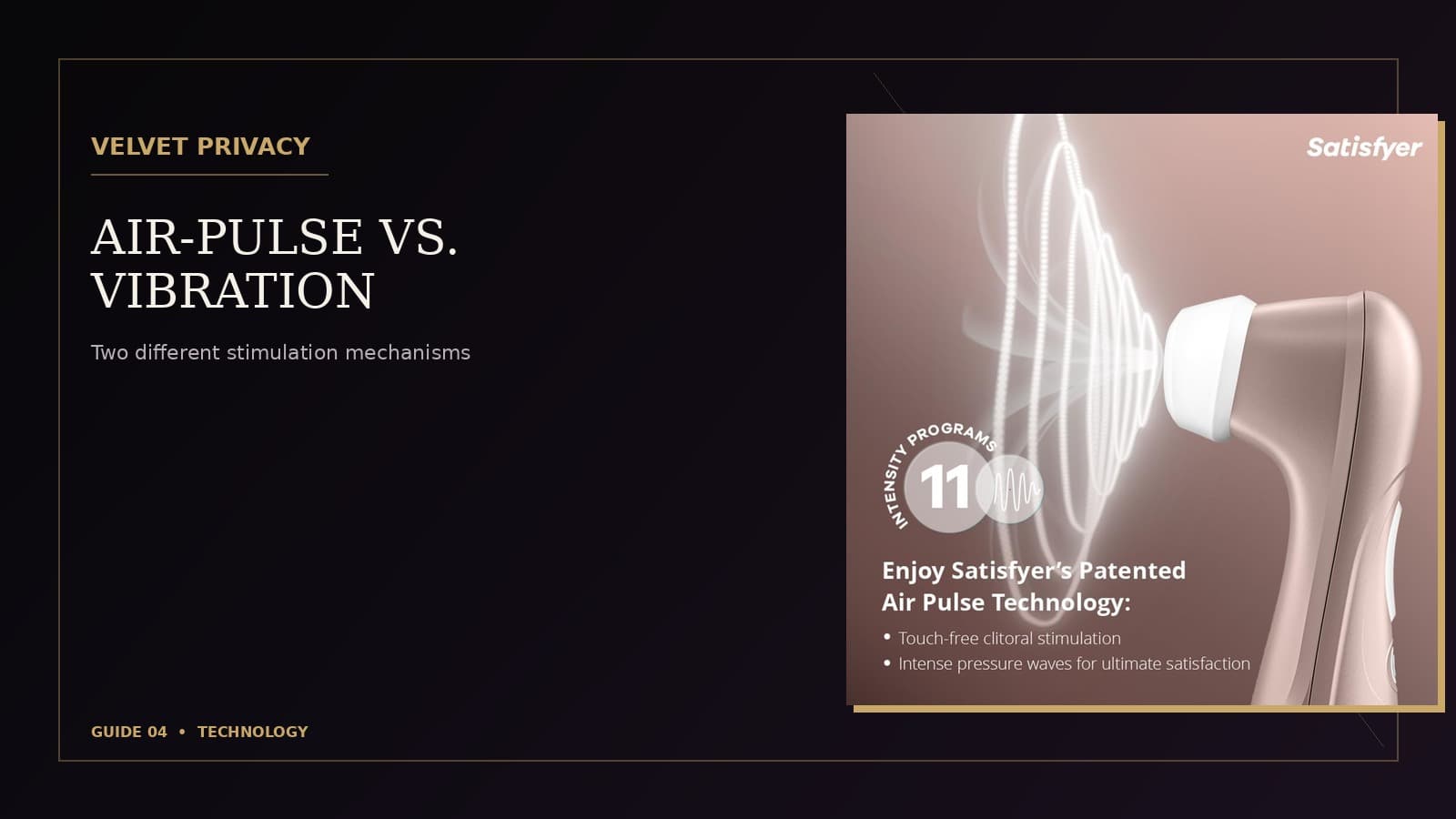
Air-Pulse works through pulsating pressure changes at the device's silicone head. The head is positioned around the clitoris so the chamber can create the intended pressure-wave effect. Satisfyer describes its Air-Pulse devices as touch-free clitoral stimulation using pressure waves.
Conventional vibration is mechanically different. A motor creates rapid movement that is transmitted through the device's contact surface. Depending on the product, that vibration may be broad, focused, pulsing or patterned. The common feature is that the vibration is physically transmitted through the material rather than being produced by an enclosed pressure chamber.
The important distinction is therefore the mechanism itself. Air-Pulse is not simply conventional vibration with a different name or a different number of settings.
The biggest practical difference: positioning
With a traditional vibrator, movement and contact can be part of the technique. The user may change the angle, pressure or location to find the preferred sensation. With Air-Pulse, positioning is more exact because the chamber needs to sit correctly around the clitoris.
Satisfyer's instructions for the Pro 2 Generation 2 recommend placing the opening accurately, holding the toy still and avoiding excessive pressure. That makes the learning curve slightly different. Instead of asking "Where should I move it?", an Air-Pulse user is often asking "Is the seal right, and is this intensity comfortable?"
Correct positioning is therefore an important part of understanding the technology rather than simply a minor operating detail.
How the sensation can differ
Descriptions of sensation are inherently personal, so a responsible guide should avoid pretending that everyone will experience the same thing. Air-Pulse is generally described as a pulsing or wave-like sensation created through pressure-wave stimulation rather than conventional direct-contact vibration. Conventional vibration tends to be recognizable as a continuous buzzing or mechanical pulsing through the surface.
The distinction can be subtle at lower settings and more obvious at higher settings, but there is no universal point where one becomes "better." People who like a distinct pressure-wave character may find Air-Pulse interesting precisely because it does not feel like the vibration they already know.
| Question | Air-Pulse | Conventional vibration |
|---|---|---|
| Core mechanism | Pressure waves | Mechanical vibration |
| Primary contact idea | Chamber around the clitoris | Vibrating contact surface |
| Key technique | Fit and seal | Contact, movement and pressure |
| Typical control focus | Pressure-wave intensity | Vibration intensity, rhythms or patterns |
| Main point of distinction | Pressure-wave stimulation | Mechanical movement |
Control and intensity
The Pro 2 Generation 2 provides 11 pressure-wave intensities. That gives the user a straightforward ladder of adjustment. Conventional vibrators vary widely: some have three settings, some have ten or more, and others use patterns or apps. The number of settings alone therefore tells you less than the type of adjustment those settings control.
A buyer should ask what they actually want to adjust. If the attraction is to pressure-wave intensity, the Pro 2's 11 levels are directly relevant. If the attraction is to multiple vibration rhythms, a conventional or hybrid device may offer a different experience.
This is an important distinction when comparing product specifications. Two devices can both advertise multiple intensity levels while those controls affect completely different mechanisms.
Noise
The Pro 2 Generation 2 is marketed with a whisper mode and a whisper-quiet motor. That does not mean silent operation. Mechanical devices still make some sound, and the amount can change with position and surroundings.
Noise comparisons should therefore be treated as relative rather than absolute. A conventional vibrator can also be quiet, particularly at lower settings. The practical question is whether the device's sound level is acceptable in your environment, not whether a product description uses the word "silent."
Satisfyer also notes that correct positioning of the silicone head helps the motor remain whisper quiet, making fit an important part of the practical experience.
Waterproofing
The Pro 2 Generation 2 is rated IPX7, which Satisfyer says makes it suitable for use in water and easier to clean. Waterproofing is not exclusive to Air-Pulse; many conventional vibrators also carry water-resistance ratings.
The interesting point is that waterproofing and stimulation mechanism are independent features. You can have a waterproof vibrator, a waterproof pressure-wave device, or a device with neither. Treat the IPX7 rating as its own specification rather than assuming it tells you anything about the sensation.
Cleaning and hygiene
Both categories need sensible cleaning. The Pro 2's silicone head and waterproof construction make routine cleaning straightforward, but the correct method is still to follow the manufacturer's instructions. Conventional devices require the same basic attention to the materials, seams and charging points.
If you want a device that is easy to rinse after use, IPX7 is a useful feature. If the product is not waterproof, cleaning can require more careful wiping and greater attention around electronics. That is an ownership difference worth considering before purchase.
Which type should a curious buyer investigate?
If you are specifically curious about a sensation that is different from conventional buzzing vibration, Air-Pulse is the obvious category to research. The Pro 2 Generation 2 is a focused example because the Air-Pulse mechanism is the central feature rather than one mode among many.
If you already know that you enjoy broad mechanical vibration or want multiple vibration patterns, a conventional or hybrid product may fit your preferences better. The important part is to choose based on the sensation you are actually seeking.
A useful decision matrix
Choose Air-Pulse when your priority is pressure-wave stimulation, a focused external design, simple physical controls and an interest in a different stimulation mechanism. Choose conventional vibration when your priority is familiar mechanical vibration, varied vibration patterns or a device designed around broader contact.
Neither category needs to be sold as a replacement for the other. They are different tools. Understanding that difference makes product descriptions easier to interpret and reduces the risk of buying something that technically matches the keywords but does not match the experience you wanted.
| If your priority is... | Consider researching... |
|---|---|
| Pressure-wave stimulation | Air-Pulse devices |
| A different stimulation mechanism | Air-Pulse devices |
| Familiar mechanical vibration | Conventional vibrators |
| Multiple vibration rhythms or patterns | Conventional or hybrid vibrators |
| Pressure waves plus vibration | Hybrid Air-Pulse products |
| A focused clitoral design | Air-Pulse clitoral stimulators |
| Broader vibrating contact | Conventional vibrators |
The bottom line
Air-Pulse and conventional vibration are best compared as two different ways of generating external stimulation. The Satisfyer Pro 2 Generation 2 uses pressure waves through a silicone chamber, with 11 adjustable intensities and IPX7 waterproofing. A conventional vibrator transfers mechanical vibration through its contact surface.
For more information about the underlying mechanism, see our technology page. For practical product specifications, visit the Pro 2 page. If you are considering purchase, the complete buying guide can bring the major ownership questions together once that guide is published.
Why "stronger" is the wrong comparison
A common mistake is to compare pressure-wave stimulation and vibration as though they were two engines competing on a single power scale. They are not. A strong vibration and a strong pressure wave can produce very different sensations.
The useful comparison is therefore about character, contact and control. If someone says a device feels "strong," that describes their experience, not a universal measurement that can be transferred directly between technologies.
This is also why simply counting intensity levels is not enough. Eleven pressure-wave settings cannot be directly compared with eleven vibration settings as though the numbers represented the same physical output.
Learning curve and technique
A conventional vibrator can be intuitive because the user can move the vibrating surface until the contact feels right. Air-Pulse introduces a slightly different technique because the chamber must sit correctly.
That can make the first few uses more educational: you learn the correct position, the amount of pressure that maintains a comfortable seal and the intensity range that works for you. Once that technique becomes familiar, the simplicity of the Pro 2 becomes more obvious.
Satisfyer specifically recommends starting on a gentle setting and holding the device still. Its instructions also note that too much pressure can reduce the sensation, which reinforces the importance of positioning rather than simply increasing force.
Why some buyers specifically search for Air-Pulse
People rarely search for pressure-wave products by accident. The technology has become a distinct category because it offers an experience that is not simply another vibration pattern.
Someone who has tried conventional vibration and wants a different sensation may be particularly interested in Air-Pulse. That is why educational content should explain the mechanism instead of presenting the technology as a mysterious premium feature.
Understanding the basic principle also makes product comparisons more useful. Once a buyer knows that Air-Pulse and mechanical vibration work differently, product descriptions become easier to interpret.
Hybrid products are a different proposition
Some Satisfyer models combine pressure waves with vibration, while the Pro 2 Generation 2 is focused on Air-Pulse. That distinction matters when comparing products.
If you want a single mechanism with a simple control system, the Pro 2's focused design is relevant. If you specifically want vibration and pressure-wave stimulation together, a hybrid model belongs in a different comparison.
Satisfyer's current product range includes Air-Pulse models that add vibration, demonstrating that "Air-Pulse" does not necessarily mean every product in the category uses pressure waves alone. Always check the individual product specification.
Use the comparison to clarify your preference
The best outcome of a comparison article is not a universal winner. It is a clearer preference.
If you read the descriptions and realize that you want a pulsing chamber-based sensation, investigate Air-Pulse. If you prefer the familiar feel of mechanical vibration, stay with that category. If you are curious about both, compare the exact product specifications and ownership features rather than assuming the names tell the whole story.
Why the device category matters
When shopping online, product categories can blur together because sellers use broad words such as vibrator, stimulator and pleasure device. The mechanism is more informative than the category label.
The Pro 2 Generation 2 is an Air-Pulse pressure-wave device, so a buyer should read descriptions of the chamber, silicone head and intensity system rather than assuming that the word "vibrator" means conventional vibration.
This distinction becomes even more useful when comparing a dedicated Air-Pulse product with a hybrid device. The product name alone may not tell you whether vibration, pressure waves or both are responsible for the available stimulation modes.
A fair comparison avoids exaggerated claims
A fair comparison also avoids claims that one technology is safer, healthier or more effective for everyone. Sensation is personal, and product preference is personal.
The useful facts are mechanical: Air-Pulse uses pressure waves, conventional vibrators use mechanical vibration, and the Pro 2 provides 11 pressure-wave intensities with an IPX7 waterproof design. Those facts are enough to make an informed comparison without turning a product category into a universal recommendation.
A practical buyer takeaway
If you are deciding between the two categories, start with the mechanism you are curious about rather than the number of settings.
The Pro 2 Generation 2 is built around Air-Pulse, so its 11 levels adjust pressure-wave stimulation. A conventional vibrator may offer a wider range of vibration patterns instead.
Once you know which basic sensation you want to explore, the rest of the specifications become much easier to compare.
Sources & References
The product-specific specifications and usage information referenced in this guide are based primarily on official Satisfyer documentation:
- Satisfyer Pro 2 Generation 2 — official product information: product mechanism, 11 pressure-wave intensities, IPX7 rating, silicone construction, whisper mode and positioning instructions.
- Satisfyer Air Pulse Technology — official technology information: explanation of Air-Pulse pressure-wave stimulation and distinction from conventional vibration.
- Satisfyer FAQ — official support information: Air-Pulse mechanism, silicone-head positioning and usage guidance.
Further Information
These external sources provide additional information relevant to the subject covered in this guide.
Common Questions,
Clearly Answered.
A concise reference to the questions most relevant to this guide.
What is the difference between Air-Pulse and conventional vibration?
Air-Pulse devices use pulsating pressure waves around the clitoris, while conventional vibrators use mechanical movement transmitted through a contact surface. They are different stimulation mechanisms rather than different strength levels of the same technology.
Does the Satisfyer Pro 2 Generation 2 use conventional vibration?
The Pro 2 Generation 2 is built around Satisfyer's Air-Pulse pressure-wave technology rather than conventional mechanical vibration. Satisfyer lists 11 pressure-wave intensities for the model.
How should the Pro 2 Generation 2 be positioned?
Satisfyer recommends placing the opening accurately around the clitoris so it fits snugly, holding the device still and starting at a gentle setting. The manufacturer notes that excessive pressure can reduce the sensation.
Is the Satisfyer Pro 2 Generation 2 waterproof?
Yes. Satisfyer lists the Pro 2 Generation 2 as IPX7 waterproof and states that it can be used in water and cleaned with soap and water or an appropriate sexual-wellness device cleaner.
Is Air-Pulse better than conventional vibration?
There is no universal answer. Air-Pulse and conventional vibration create different types of stimulation, so the more useful question is which mechanism and control style match your personal preference.
Related
Guides.
Continue exploring related information from the Velvet Privacy guide library.
How Air-Pulse Technology Works: Inside the Satisfyer Pro 2
Discover how Air-Pulse technology works in the Satisfyer Pro 2 Generation 2, from its pressure-wave chamber and silicone head to positioning and 11 intensity levels.
Satisfyer Pro 2 Generation 2 Buying Guide
A complete buying guide to the Satisfyer Pro 2 Generation 2, covering Air-Pulse technology, 11 intensity levels, size, materials, waterproofing, charging, warranty, privacy and everyday ownership.
How to Clean the Satisfyer Pro 2 Generation 2
Learn how to clean the Satisfyer Pro 2 Generation 2 properly, including how to clean the silicone head and Air-Pulse opening, rinse away residue, dry the charging area and store the device.
Satisfyer Pro 2 Generation 2 Shipping, Returns, Refunds & Warranty Guide
A practical guide to shipping, tracking, returns, refunds, warranty coverage and support for the Satisfyer Pro 2 Generation 2, including what to do when an order or product issue occurs.
Satisfyer Pro 2 Generation 2 Waterproof IPX7: What the Rating Means
A practical guide to the Satisfyer Pro 2 Generation 2 IPX7 waterproof rating, including water use, cleaning, charging, silicone care and what IPX7 actually means.
Where to Buy Satisfyer Pro 2 Generation 2 Online
A practical guide to buying the Satisfyer Pro 2 Generation 2 online, with a focus on product verification, discreet purchasing, privacy-conscious checkout, shipping, tracking, returns and support.
More From
Velvet Privacy.
Continue from this guide to the relevant product, technology and support resources.
Continue
Exploring.
Browse the complete guide library for practical information about products, technology, care, purchasing, privacy, payments, shipping and support.